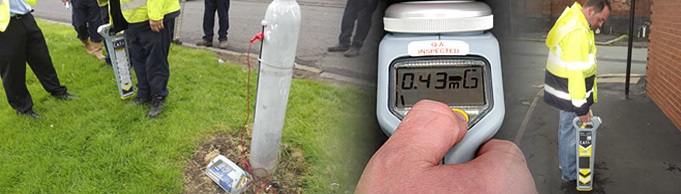
Showing posts with label Cable Avoidance. Show all posts

Thursday, 29 August 2024

Safeguarding Subterranean Excavation: CAT and Genny Training

The Importance of Safe Digging Practices

When you receive an excavation-related contract or utility assignment, it is your responsibility to be aware of the safety procedures associated with any subterranean facility. Working underground always carries the risk of encountering something in an unexpected location. Therefore, incorporating a safe work strategy when digging is crucial. Start by creating a detailed design, followed by locating and identifying any underground utilities, and using safe digging techniques. In addition to EUSR HSG47, operatives must complete a CAT Course.


Advantages for the Student

By taking this course, students will gain knowledge in the following areas and apply it practically to locate and avoid utility services:

●     Environmental, health, and safety duties

●     Site-specific risk assessment

●     Individual safety gear

●     Subterranean utility services risks

●     Health and safety laws and recommendations

●     Finding utility services using plans and approved techniques

●     The guiding principles and operations of the CAT and Genny

Benefits for Employers

Employers who send their employees to this course can expect the following advantages:

●     Reduced risk from health and safety hazards related to utility service damage

●     Lower costs associated with damaged equipment and utility services

What This Course Will Teach You

The standard for this course is based on the following National Occupational Standards:

●     EUSMUNC06: Locate and Avoid Services for Utility Networks Construction

●     EUSEPUS044: Location and Identification of Subterranean Utility Services in the Electricity Power Utilities Sector

The course also covers pertinent guidelines from HSE documents:

●     HSG47: Avoiding Danger from Underground Services

●     HSG150: Health and Safety in Construction

When the standard is met, participants will demonstrate successful performance by showcasing the following abilities and knowledge:

●     How to read line search documents and utility drawings

●     How to locate underground services using detection equipment

●     How to recognise the risks and hazards associated with subterranean services

What to Bring to the Course

Participants should bring the following items with them:

  1. High-visibility jacket or vest
  2. Passport photo for their EUSR card

Safety-Critical Training: Beyond the Basics

This safety-critical training increases the knowledge needed to safely locate underground utility services through both theoretical and practical examinations. The education goes beyond standard "in-house" sessions and aligns with both EUSR and National Occupational Standards. It is often referred to as EUSR HSG47 or CAT & Genny training.

This course is beneficial for individuals who need to read utility drawings and/or use service detection equipment to locate a range of subsurface services.

Tuesday, 17 March 2020

Undertaking Any Type Of Excavation Work Can Be Dangerous


Undertaking any sort of excavation on public roads, as well as many other places, can be fraught with danger. The reason is that there are underground services of all sorts including electricity cables, water pipes, gas pipes, telecoms, sewage pipes, and they can be anywhere. We all have electricity in our homes, and most have telephone landline connections. We all have water pipes and we all use sewage pipes. Many properties also use gas, and then there are fibre-optics and other services as well.

Striking one of these will cause damage to the service at the very least and may mean that businesses are interrupted and/or people are left sitting in the dark at 4.00 pm on a winter’s afternoon. For example, if a telephone cable is cut, it can mean that there is no internet access, which in turn is going to affect the income of any business that depends on it for its’ operation.

Read more: cable avoidance

Monday, 16 March 2020

Location Of Underground Services Is Critical Before Any Excavation Work


Many contractors need to carry out some sort of excavation work very often. When you need to create a new build, it needs foundations, which involves digging. Street works almost always involve excavation. Ground works contractors, by definition, spend their lives digging.

The problem is that, wherever you need to dig, there may be underground services. In many places, such as pavements and roadworks, there almost certainly will be underground services, although it is possible that there may not be in a little used country lane. Even so, there could be.

Read more : Cable Avoidance

Tuesday, 13 August 2019

Questions to Ask When Choosing Cable Avoidance Tools

If you are working with or within the underground utility sector, or breaking ground, you are likely to come across the recommendation of using cable avoidance tools. With the help of these tools, you can avoid striking an underground cable or wiring, and therefore, prevent any kind of injury or project delay. However, there are certain important questions that you need to ask when choosing cable avoidance tools.


  • Will you use the CAT in isolation or with Genny?: This is a trick question because best practice demands that you always use CAT and Genny together. In isolation, CAT can only detect live power cables. With Genny, it can detect cables and wires that do not have current flowing through them.
  • Over what distance do you need to trace buried utilities?: The industry-standard detection frequencies are 8khz and 33khz. However, there are more advanced models available in the market today that can emit additional frequencies and allow you to detect signals over much longer distances.
  • Do you need to store data for analysis?: If you are simply using cable avoidance tools for marking up the ground, you can get a standard CAT & Genny. However, if you want to store data for future analysis, you need an advanced model.
The last question you need to ask is whether you are competent enough to use CAT & Genny. If you or anyone on your team does not have expertise in using cable avoidance tools, it is advised that you undertake a cable avoidance training course.

Friday, 26 July 2019

How Does Cable Avoidance Training Help?

Before digging up the ground, it is crucial to find out where exactly the underground utility services are located. The UK is already reeling under 60,000 cables strikes in a year and you do not have to add on to that number. Striking underground utilities is not just life-threatening, but also expensive and a nuisance to the people staying around the construction or excavation area. This is why it is important that you enrol yourself for cable avoidance training and if you do so, you can achieve the following benefits.


  • The full potential of the equipment is maximised: Today, cable avoidance tools are capable of so much more. The latest models are equipped with GPS, which means that all the work can be stored, as well as, tracked. In order to take full advantage of the cable avoidance tools in detecting buried utilities, you need to get proper training. Training programmes will teach you the use, as well as, the limitations of the equipment.
  • Project can be completed quickly and cost-effectively: By knowing how to use CAT, you can avoid hitting buried utilities. This means that there will be no delays in your project and you can complete it within time and budget.
  • Improves work environment: The safety of the workers is crucial for any project. By avoiding cable strikes, you can create a safe working environment.
So, all you have to do now is look for a reliable training company and undertaking CAT training course.

Monday, 13 May 2019

Is Cable Avoidance Training Indispensable? Find Out!

Contractors and workers have to be extra careful when excavating or digging up an area in the UK. There are miles of underground utility services and if they are damaged, it can cause serious injury to the workers, along with disruption of services and resultant financial losses. Even though most supervisors or contractors take care to avoid accidental cable strikes, more than 60,000 cases are reported each year. This is because most of them are not aware of the right use of the two main tools used for the detection of underground utility services - CAT and Genny.


The CAT, also known as cable avoidance tool is used to locate live power cables that have power running through them. But, in order to locate all the buried services, it is mandatory to use the CAT & Genny together. The Genny or signal generator is used to apply a signal to the underground services like, telecoms, gas pipes, water pipes and so on, which the cable avoidance tool is able to detect.

The problem with using CAT & Genny is that you cannot simply purchase the equipment, read the instructions and consider yourself an expert. You need to undertake proper cable avoidance training to understand everything that the CAT & Genny are able to do and the things that they cannot do.

In the UK, there are several specialist companies providing professional CAT & Genny training programmes that you can register for to learn everything about the equipment.

Sunday, 10 March 2019

The Importance of Cable Avoidance Training

Any contractor undertaking any type of excavation work should understand the necessity for taking every precaution to avoid striking any type of underground service. Underground pipes and cables can be absolutely anywhere – even in places where you would least expect to find them. This means that no spade should even be inserted into the ground before a thorough survey of the area to be dug has been carried out using the appropriate cable avoidance tools. 


The two main tools used to locate buried services are the CAT (Cable Avoidance tool) and the Genny (signal generator). Between them these two tools can locate very many underground services, but even so they have their limitations. This is why specialist cable avoidance training should be undertaken by anyone who has to locate underground services. It is not sufficient to purchase the tools and simply read the manuals.

Certainly, the manuals will show how to operate the two pieces of equipment, but there is nothing to beat being taught how to use them by a professional. When you go on a proper course with an instructor who knows everything there is to know, you may be surprised at some of the things that you learn that were not in the manuals. You will also get practical experience out in the field which is not just invaluable, but essential. Learning how to use the CAT and Genny in the classroom is one thing but putting into practice what you have learned will open your eyes to a whole lot more.    

Tuesday, 20 November 2018

City & Guilds Level 2 Cable Avoidance Training

Level 2 cable avoidance training is training undertaken to obtain the City & Guilds Level 2 Award in Safe Location and Avoidance of Underground Services (6038-01). This award is for people working in construction or associated industries who need to locate and avoid underground services. 


This qualification covers the purpose of safe location and avoidance of underground services. It takes account of the need to use different types of service drawings and develops skills required to identify, detect and mark out services and plan for these activities. Finally, the qualification covers the theory of methods of safe excavation. The total qualification time is 14 hours and includes 12 hours of guided learning time and two hours spent separately in preparation, study, and assessment.

Operatives learning cable avoidance must pass a test to demonstrate that they understand the purpose of the safe location and avoidance of underground services. They must understand service plans required when preparing to work on or near underground services. They must be able to plan for safe location and avoidance of underground services and be able to identify, detect, and mark them out. They also have to understand the methods of safe excavation of underground services.

Read More Information To Visit - Level 2 cable avoidance training

Wednesday, 21 March 2018

Things to Consider When Purchasing A CAT (Cable Avoidance Tool)

When you are considering the purchase of a CAT (Cable Avoidance Tool) there are a number of things to watch out for.  

First, are you going to use the CAT on its’ own or in conjunction with a signal generator (Genny)? Best practice suggests that you should certainly use both in conjunction. When a CAT is used on its’ own in Power Mode it can only locate cables that have power running through them at the time. This is fine if you are working in, say, a shopping mall at night when the lights are on as you should be able to locate the cables quite easily.

CAT and Genny

However, it is a totally different matter if you are working in daylight hours as it is likely you won’t find them at all. Furthermore, only when used together will the CAT be able to locate plastic pipes, water pipes, telecoms, and so on. This is why in most instances it is critical to use the CAT and Genny together.

Do you need to know only the lateral position of the cable or would you like to know its’ depth as well? In the past, most CATs would only show the location of the cable, and not its’ depth. However, you can now buy a CAT that will show you the depth which is an extremely useful feature – some might say vital. This means that if you are only going to be digging down a couple of feet and you know that the cable is eight feet down you can proceed with much more confidence – although you should still err on the side of caution of course.

Another consideration is the distance you need to cover. Used in conjunction with a Genny, most CATs use two standard frequencies of 8khz and 33khz. However, some CATs have two extra frequencies available which permit signals to be detected over much longer distances. This can be extremely useful when you are operating over longer distances because it will save a lot of time as it avoids moving the Genny as you work the site.


Friday, 23 February 2018

Using Cable Avoidance Tools Perfectly

A Cable Locator (CAT) is used for cable avoidance before any excavation work is carried out and is essential to avoid injury or even death. Cat & Geny devices are used by most because many people are killed or injured every year so using the equipment properly is essential. For an enhanced performance the use of th Signal Generator (Genny) which applies a signal to a cable or metal pipe so that harder to reach services can be traced.

cable avoidance

A Signal Clamp is an easy and safe way to connect the Genny to a cable or a pipe in order to get an accurate tracing. It may also be useful to have a clamp in difficult or unsafe conditions where there is a live power cable or telecoms. It is recommended because precision is key when looking for cables and pipes that are underground. The cost and risks involved with striking a gas pipe are not worth thinking about so correct use of the equipment is essential.

How to take a reading
  1. Select mode
  2. Set the sensitivity to maximum
  3. Hold on/off trigger in the on position
  4. Search in grid pattern show
  5. When the signal is detected, move the CAT forward and back and turn the sensitivity down until only the peak response can be heard and seen.
Read more on : Cat & Geny